
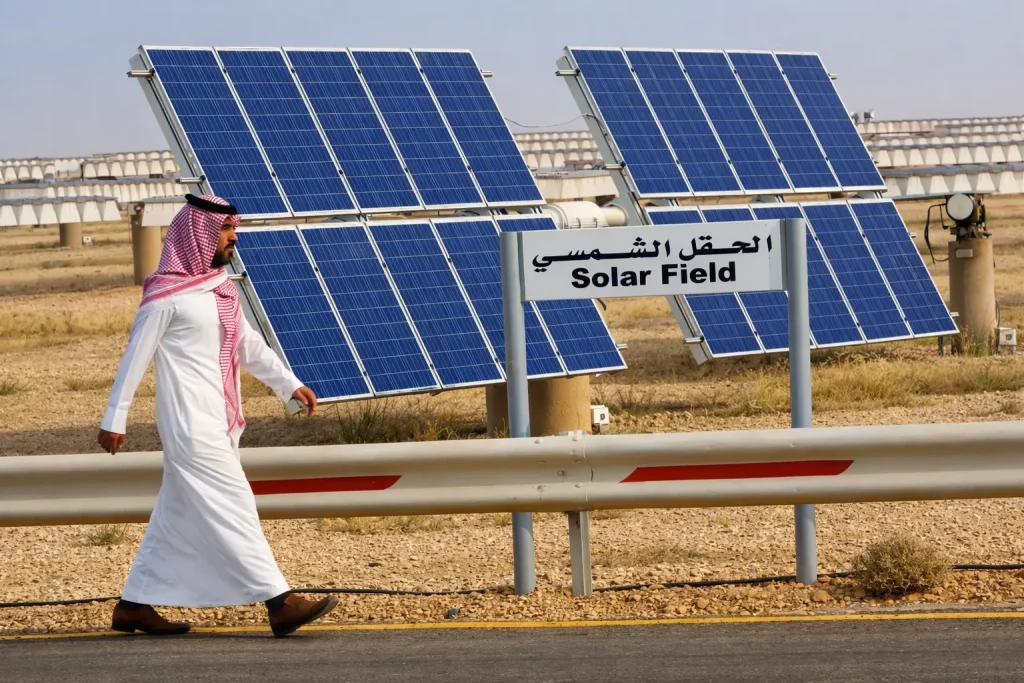
Saudi Arabia has officially overtaken the UAE in the Gulf’s fast‑growing renewable energy push, marking a major shift in a region long dominated by oil and gas.
GCC’s Big Renewable Dream: 165GW by 2030
The six GCC countries have set an ambitious target: 165 gigawatts of renewable energy by 2030. So far, they’ve installed around 24GW — meaning there’s still a long road ahead.
To close the gap, the region will need another $61 billion in investment, according to the Baker Institute, on top of the $38 billion already committed.
Most of this growth is coming from solar, with wind still playing a very small role.
Solar Dominates — And Saudi Arabia Takes the Lead
Solar capacity in the GCC jumped 60% in the past year, reaching 23GW out of the total 24GW, says the International Renewable Energy Association. That’s double Dubai’s peak electricity demand.
The biggest mover? Saudi Arabia, which boosted its solar capacity by 92%, now accounting for nearly half of the GCC’s total — overtaking the UAE for the first time.
Saudi Arabia’s mega‑projects include:
- Shuaibah 2 Solar Project
- Sudair Solar Plant
- Dumat Al Jandal Wind Farm
Under Vision 2030, the kingdom aims to:
- Generate 50% of its electricity from renewables
- Install 100–130GW of renewable capacity in the next four years
But Can the Region Keep Up the Pace?
Progress across the GCC is uneven, analysts warn.
“The GCC is moving faster than it was five years ago, but progress is not even,” said Nishant Kumar of Rystad Energy.
He notes that Saudi Arabia, UAE, Oman, and Qatar have the clearest short‑term plans. Saudi Arabia is “accelerating sharply,” but its huge 2030 target carries “high delivery risk.”
Meanwhile, the UAE continues to shine with the strongest delivery record.
The country aims for 44% renewable energy by 2050, but forecasts suggest it could hit that a decade early — by 2040.
Other regional players like Egypt are also expanding solar and wind projects.
Why Renewables Matter for the Gulf
Renewables — along with battery storage, nuclear energy, carbon capture, and carbon credits — are central to the GCC’s net‑zero strategies.
But there’s another motivation: More renewable power at home means more oil and gas available for export.
Net‑zero targets across the region:
- UAE & Oman: 2050
- Saudi Arabia, Kuwait, Bahrain: 2060
- Qatar: No fixed timeline
Kuwait Falls Behind
Kuwait remains the GCC’s slowest mover.
It aims for 15% renewable power (4.5GW) by 2030, but currently has only 114MW installed. With almost no new projects awarded, analysts say Kuwait is unlikely to meet its target.
Will the Iran War Speed Up Renewables?
Analysts say no — at least not in the Middle East.
Unlike Europe and other regions, the Gulf’s renewable plans are already large, and hydrocarbons still dominate their economies. Plus, repairing energy infrastructure damaged by missile and drone strikes is expected to divert funds away from overseas renewable investments.